

The Republican House of Representatives in Kentucky, the Chairman of the House of Representatives Supervisory and Government Reform Committee, James Comer, recently requested the participation of CEOs of various games and forums on the issue of cyber radicalization. The operation originated in the killing of Charlie Kirk, a United States Republican who had previously been shot at, and James Comer asked for testimony from platform executives V, Discord, Twitch and Reddit.

In his statement, James Comer stated that the Government had a “responsibility to regulate cyber platforms used by extremists to promote political violence” and asked the CEOs “to indicate what measures would be taken to ensure that the platforms were not used in bad faith”. It has been learned that the executives of these enterprises were ordered to attend the 8 October hearing, which will focus on “the radicalization of the users of the Internet Forum, including public incitement to politically motivated violence”.
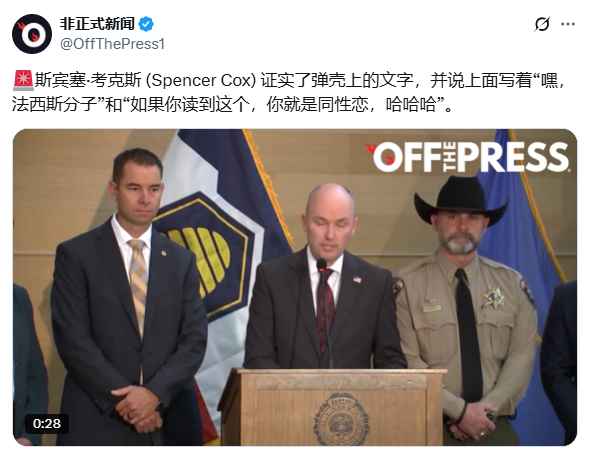
According to a survey by the Utah police, Charlie Kirk, a suspect of a senior cyber and fanatical gamer, not only has a cyberblock on his shell and a Hellsguard-2 bombing directive, but Discord and Steam platforms are frequently used, among friends, as “deep network addicts”. This evidence, coupled with public opinion reactions following the assassination, prompted United States conservative officials and the media to call for greater regulation of social media.
There is a long history of academic research on the complex and sensitive multidimensional relationship between play and extreme violence. In recent years, researchers have continued to study the culture of play and the process of socialization, focusing on how social interaction in the online playing environment interacts with violent radicalization. For example, research has been conducted on the frequency with which players encounter hate speech within the game, on extremist small communities on the Steam platform, and on ways to build the resilience of play communities to radicalization.
The academic community has been careful to focus on the intersection of cultural and social dynamics and the field of play and to emphasize that there is little evidence of a direct link between play and violence. Despite a lack of evidence, video games are often the source of violence and are the subject of accusations by those concerned. Since the 1990s, sociologists have studied the impact of games and at best only found a weak correlation between games and violence.
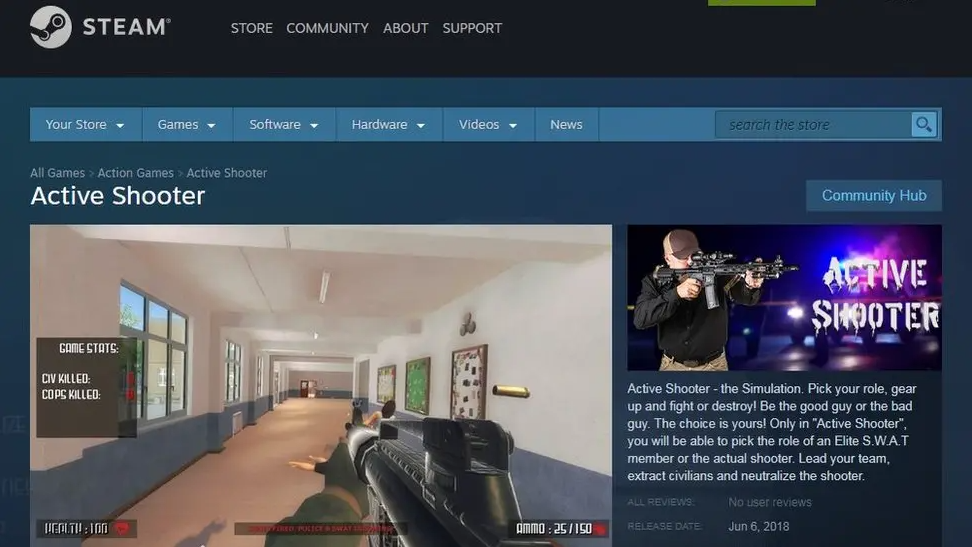
(Active Shooter is banned for simulating school shooting)
While researchers are careful to explore the specific conditions under which cyberviolence occurs in a game environment, current United States Government policies have severely constrained research. Most of the studies were originally supported by the Department of Homeland Security’s Sexual Violence and Terrorism Prevention Financing Programme, but the plan was significantly reduced in July. Other funding for violence prevention research at the National Health Institute has also been severely reduced.